
Dumps
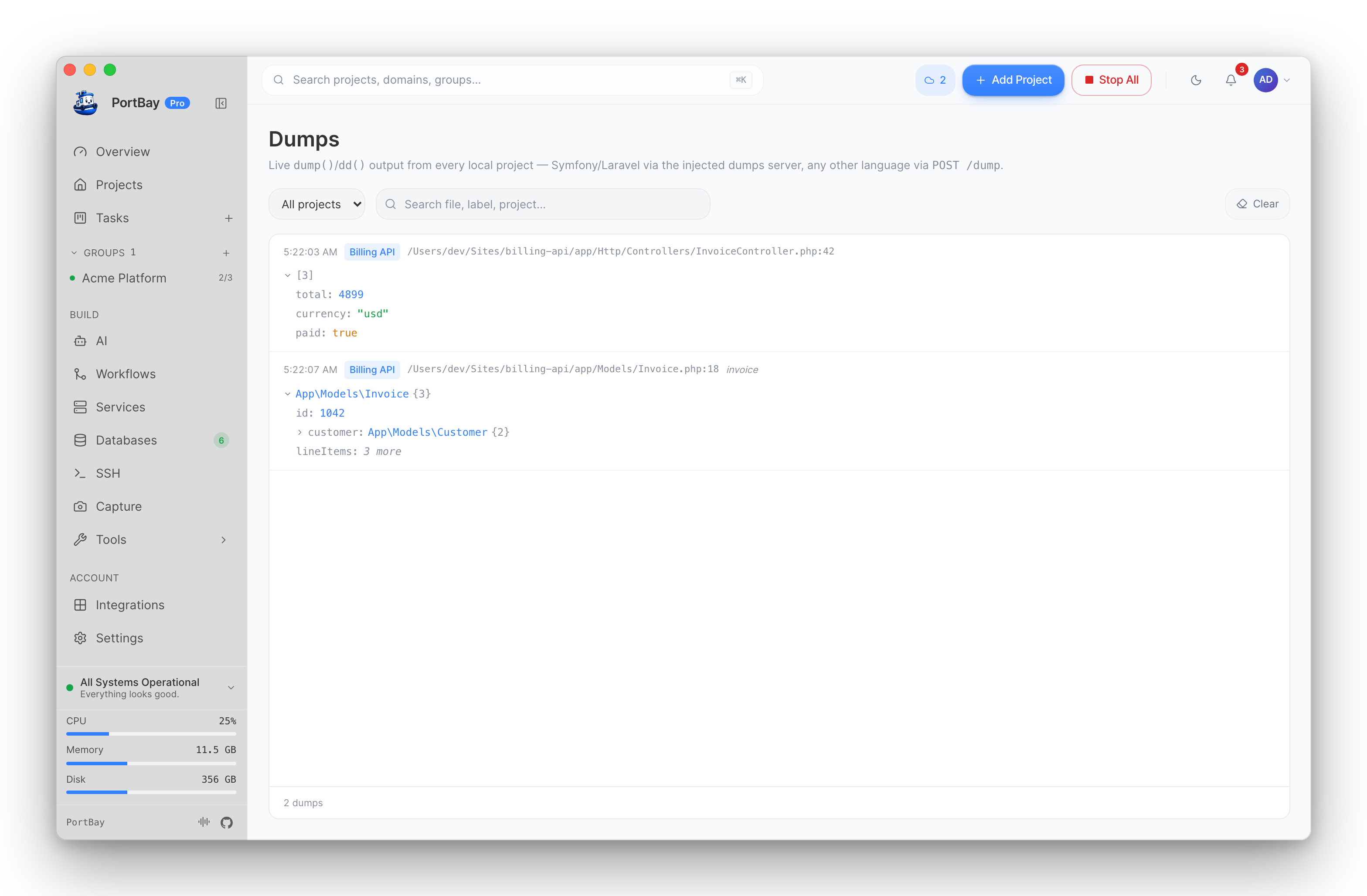
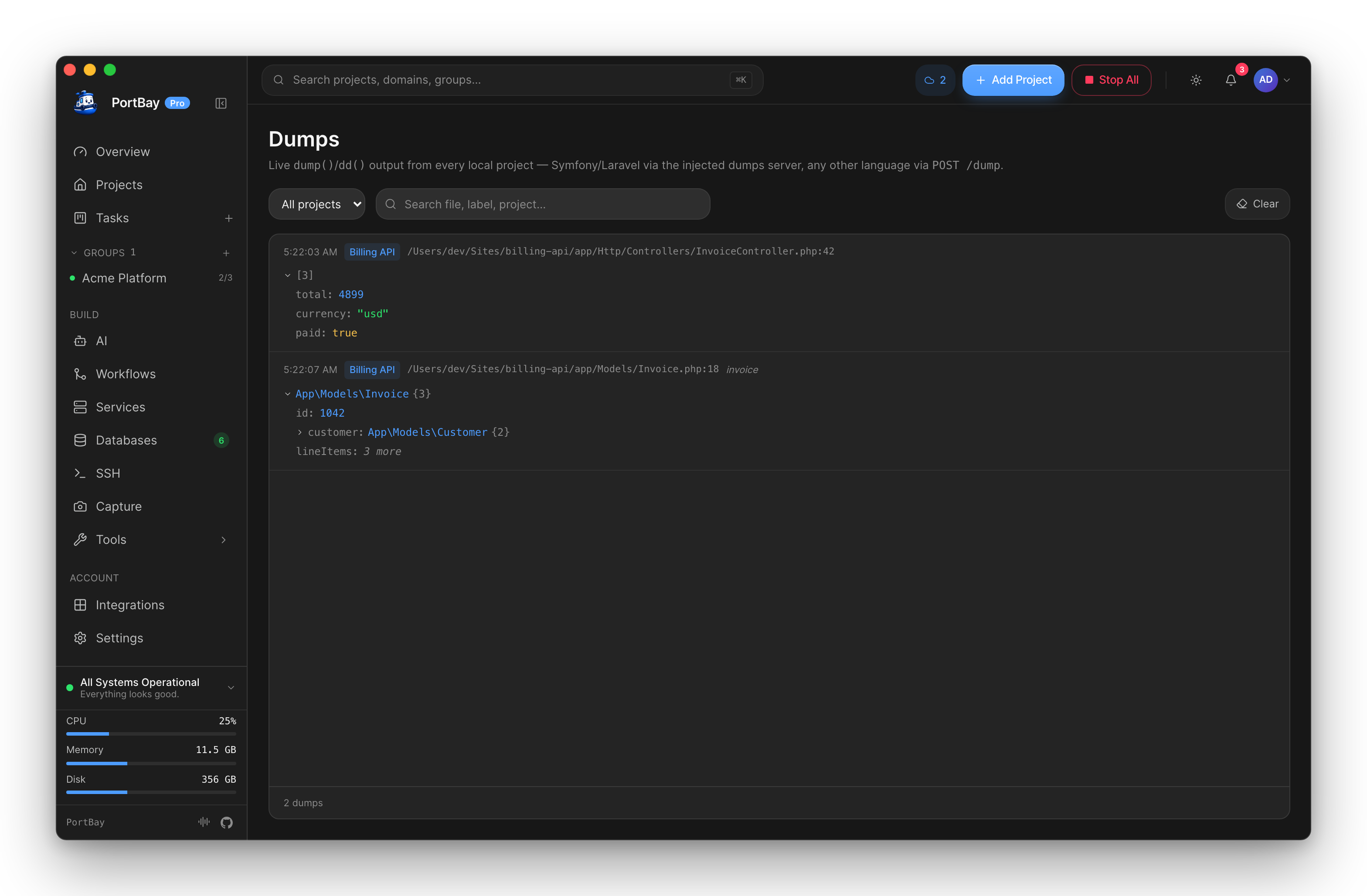
The Dumps page (/dumps) is a universal, live, time-ordered viewer for dump()/dd() calls from any project — the same snapshot-then-listen shape as the Log Viewer: an initial snapshot on load, then a live event stream for everything after. Each entry shows a project badge, the file:line it was called from, and an expandable value tree.
Enabling It
Dumps is opt-in and off by default — enable it from Integrations → Apps tab. Once enabled, the listener starts immediately (no restart needed) and stays on across app restarts until you disable it again. You can still open /dumps while it's disabled — it just shows a disabled-state card instead of an empty state, so an old bookmark or nav history doesn't look like a bug.
Per-project, there's a separate dumps toggle: turning it on injects VAR_DUMPER_SERVER and VAR_DUMPER_FORMAT=server into that project's environment, so Symfony/Laravel's dump()/dd() reach PortBay's listener instead of rendering in-page or in a browser response.
How It Works
The listener is always-on while enabled — an in-process pair of accept loops on AppState (not a Process Compose child, not a bundled sidecar binary — the same shape as PortBay's OpenAI-compatible server), so dump() never blocks waiting for a viewer: every frame is parsed and pushed into a bounded ring buffer (500 entries, oldest dropped first) whether or not the /dumps page is open.
- VarDumper wire protocol — the raw protocol Symfony/Laravel's
ServerDumperspeaks, on127.0.0.1:9912by default (scanning upward if taken). POST /dumpHTTP intake — a minimal HTTP endpoint on127.0.0.1:9913by default, for any other language to push a dump manually. Request bodies are hard-capped at 1 MiB, enforced by bounding the actual read rather than trusting aContent-Lengthheader.
Loopback only. Neither listener ever accepts a connection from outside 127.0.0.1 — this is a local debugging aid, not a network service.
When PortBay itself isn't running, the TCP connect from ServerDumper is simply refused and Symfony falls back to its own in-page dumper automatically — no PortBay-side change is needed for that fallback to work.
Clearing
The Clear action wipes the ring buffer only — it doesn't affect anything already delivered to a listening client, and matches the Log Viewer's "Clear" semantics (view-only; there's no on-disk dump history to delete, since dumps are never persisted to a file).
See Also
- Services — the dumps listener's live status (running, bound ports) is one of the sidecar cards there.
- Integrations — where the feature is enabled/disabled.